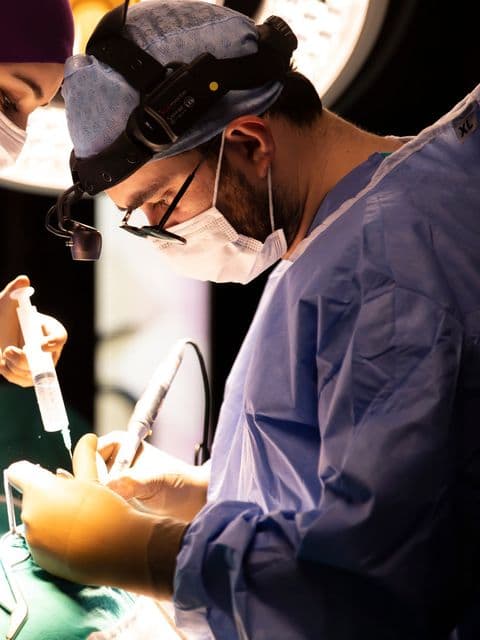
Ultrasonic Rhinoplasty
Ultrasonic (piezo) rhinoplasty is a rhinoplasty in which the nasal bones are shaped with tips vibrating at ultrasonic frequency, for patients whose bony bridge needs to change, such as a hump or a crooked or wide bridge. It aims to shape the bone while sparing the surrounding soft tissue as much as possible, which can help reduce bruising and swelling.
 Medical content: Op. Dr. Furkan Şengöz
Last reviewed:
Key facts
- Anaesthesia
- General anaesthesia
- Approach
- Usually the open technique
- Hospital stay
- Usually 1 night
- Splint removal
- Around day 7
- Back to desk work
- Usually 7-14 days (first operation)
- Final result
- Usually 12-18 months
Who is ultrasonic rhinoplasty for?
Ultrasonic rhinoplasty is not a separate operation. It is a rhinoplasty in which the nasal bones are shaped with an ultrasonic (piezo) device. Work on the tip, the cartilage and the septum is planned and done in the same operation, as in any rhinoplasty.
The technique is used when the bony part of the nose needs to change, for example:
- A hump on the bony bridge
- A crooked bony bridge
- A bony base that looks wide from the front
- Uneven nasal bones, including after a previous operation
How does a piezo device shape bone?
The device has small tips that vibrate at ultrasonic frequency. These vibrations cut or rasp hard, mineralised bone. Soft tissue, such as the lining of the nose, blood vessels and skin, is elastic, so it is affected far less. The aim is to shape the bone while sparing the surrounding tissue as much as possible.
This control means a hump can be reduced in thin layers. A crooked or wide bony bridge can be cut along the planned line and moved into its new position.
How is it different from a chisel and rasp?
In the conventional method, the nasal bones are cut with a chisel (osteotome) and a hammer, and a hump is filed down with a rasp.
With a piezo device, the bone is cut and shaped under direct view, in small steps. This is why it can help reduce trauma to the tissue around the bone, and with it bruising and swelling. The goal of the operation stays the same. Only the way the bone is shaped changes.
Does it need the open technique?
Usually, yes. The piezo tips have to reach the bone directly, so the soft tissue is lifted off the bony framework over a wider area than in a conventional operation. This is usually done with the open technique, through a small incision between the nostrils. The fine scar it leaves fades considerably over time.
When is a piezo device not needed?
If only the tip or the cartilage is changed and the bones are left as they are, there is no bone to shape. In that case a piezo device is not needed. Whether it is used, and where, is decided at planning.
How are the bones and the breathing planned?
As an ENT surgeon, Op. Dr. Furkan Şengöz examines the inside of the nose with an endoscope before planning. Shape and breathing are planned as one operation: the septum, the turbinates and the nasal valve are assessed together with the bridge. Narrowing the bones also changes the space inside the nose, so the airway is part of the same plan.
On the profile, values such as the nasofrontal angle (115-130°), the nasolabial angle (90-110°) and the nasomental angle (120-132°) are measured. These values are a starting point, not a target. The final plan, including how long the operation will take, is agreed with you at the examination.
What is recovery like?
- Hospital stay: usually 1 night after general anaesthesia.
- First week: swelling and bruising peak, then start to fade.
- Splint: removed around day 7.
- Desk work: usually after 7-14 days for a first operation.
- Final shape: most of the swelling goes down in the first few months. The shape usually settles within 12 to 18 months.
Patients from abroad usually plan 5 to 7 nights in Istanbul. Follow-ups after you return home can be online.
What are the risks?
Like any surgery, ultrasonic rhinoplasty carries risks. These include swelling that lasts longer, bleeding, infection, asymmetry, small irregularities on the bridge, changes in breathing and the need for a revision. Your own risks are discussed at the examination.
The process
Examination
Photos of your face, your skin thickness and an endoscopic examination of the inside of your nose show what the bones and the airway need.
Planning
The target shape of the bridge and any work on the septum, turbinates or tip are agreed with you as one plan.
Surgery
Under general anaesthesia, usually with the open technique, the nasal bones are shaped with a piezo device.
Recovery
The splint comes off around day 7. Follow-ups happen in person, or online if you live abroad.
Frequently asked questions
Is ultrasonic rhinoplasty a different operation from rhinoplasty?
No, it is a rhinoplasty in which the bones are shaped with a piezo device instead of a chisel and rasp. The tip, the cartilage and the septum are treated in the same operation, as in any rhinoplasty.
Will I have less bruising after ultrasonic rhinoplasty?
It can help, but it cannot be promised. The vibrating tips act mainly on bone and aim to spare the soft tissue around it, which can mean less bruising and swelling in the first days. How much you get still depends on your skin, your healing and how much work your nose needs.
Can the ultrasonic technique be used in revision rhinoplasty?
Yes, when the bones need reshaping again, for example a remaining hump, an uneven bridge or bones that healed out of line. Scar tissue makes a revision more complex, so it is planned after an endoscopic examination and usually at least 12 months after the previous operation.
Is ultrasonic rhinoplasty suitable for thick skin?
The bones can be shaped with a piezo device whatever your skin type. Thick skin, however, shows fine bone detail less clearly and holds swelling longer, so the final shape can take up to 18 months. Your skin is assessed at the examination and taken into account in the plan.
Does ultrasonic rhinoplasty shorten the recovery time?
The main milestones stay the same: the splint comes off around day 7, and desk work is usually possible after 7-14 days for a first operation. The aim is a calmer first week with less bruising. The final shape still usually settles within 12 to 18 months.
Sources
- The Role of Piezoelectric Instrumentation in Rhinoplasty Surgery. Aesthetic Surgery Journal, 2016
- Ultrasonic Rhinoplasty and Septoplasty for Dorsum Preservation and for Dorsum Structural Reconstruction. Facial Plastic Surgery Clinics of North America, 2023
- Is Piezosurgery Associated with Improved Patient Outcomes Compared to Conventional Osteotomy in Rhinoplasty? A Systematic Review and Meta-Analysis of RCTs. Journal of Clinical Medicine, 2024
- Piezoelectric Versus Conventional Rhinoplasty: A GRADE-Assessed Systematic Review and Meta-analysis of Randomized Controlled Trials. Aesthetic Surgery Journal, 2026